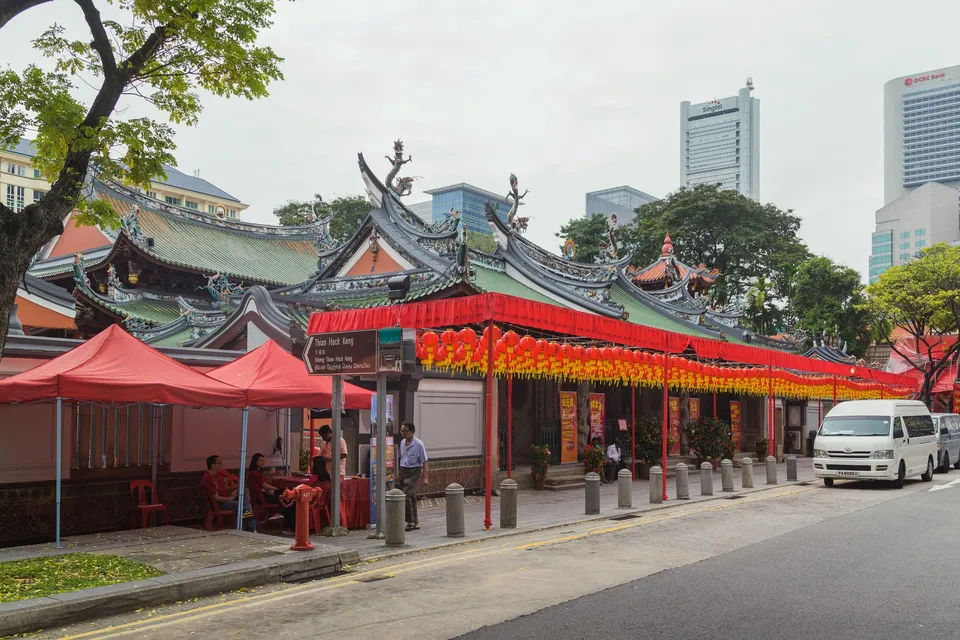
Thian Hock Keng Temple
Thian Hock Keng was built on the waterfront. Then the sea moved
- Where
- Chinatown
- Hours
- Daily 7.30am–5pm, last entry 4.45pm
- Price
- Free entry, per Chinatown.sg
To understand Telok Ayer Street, remember that this temple was built on the beach.
Thian Hock Keng is the one Chinatown temple to see properly if you only see one, and the best time is early, before Telok Ayer fills with the lunch rush. Give it half an hour, look up more than you look around, and treat it as the start of a slow walk along one of the city’s oldest streets. It is an active place of worship rather than a museum, so dress modestly, keep your voice down and step around anyone praying.
Why it matters
Stand outside today and you are surrounded by office towers and shophouse bars. When it was built, you would have been looking at the sea. The temple stands on what was the shoreline of Telok Ayer Basin, where Chinese immigrants stepped off their boats; many went straight to a small shrine on the shore to thank Mazu, goddess of the seas, for a safe crossing. The joss house dates to around 1821–22, and the temple itself was built between 1839 and 1842, with materials imported from China and carvings by Fujian craftsmen, at an estimated cost of 30,000 Spanish dollars. Tan Tock Seng’s 3,000 was the largest recorded gift. Mazu’s statue arrived from China and was installed after a grand procession in 1840; the same year, the Hokkien Huay Kuan clan association was founded within the compound, and in 1849 Tan Kim Seng led the building of Chongwen Ge, Singapore’s first Chinese school.
What to look for
The name translates as the Temple of Heavenly Happiness, and the craft is the reason to linger. Look for the dragons, phoenixes and deities in the carvings, the broken-porcelain decoration on the roof ridges (a Fujian technique), the carved granite columns and the painted rafters over the front gate. Chinatown.sg says the whole structure went up without nails. Then find the plaque reading Bo Jing Nan Ming – Gentle Waves over the South Seas – presented by the Guangxu Emperor in 1907.
Some details show how international the port was: a 1906 renovation added a wrought-iron gate from Glasgow. Behind the main hall is a smaller shrine to Guanyin, and the temple also houses Baosheng Dadi, the god of medicine, Guan Yu, the City God and Confucius, among others. To the right of the altar is a courtyard shrine to the ancestors; to the left, the pagoda that once held the school.
How to do it well
It opens at 7.30am and last entry is at 4.45pm, so this is a morning or lunchtime visit rather than an evening one. Telok Ayer MRT is on the doorstep. Al-Abrar Mosque and Telok Ayer Chinese Methodist Church are a short walk on, which makes this the natural start of a loop. Thian Hock Keng was gazetted as a National Monument in 1973 with Chongwen Ge, and its 1998–2000 restoration earned an honourable mention in the UNESCO Asia-Pacific Heritage Awards in 2001. Stand at the gate on the way out and picture the waves where the traffic now runs.
Good to know 158 Telok Ayer Street, by Telok Ayer MRT. Open daily; last entry 4.45pm (hours are in the facts box). It is an active place of worship, so dress respectfully. Check the temple’s own site before you go.
Thian Hock Keng Temple | 158 Telok Ayer Street, Singapore 068613 | Nearest MRT: Telok Ayer
Plan your visit
- Where
- 158 Telok Ayer Street, Singapore 068613 · Telok Ayer MRT
- Opening hours
- Daily 7.30am–5pm, last entry 4.45pm
- Cost
- Free entry, per Chinatown.sg
- Good for
- Myself, A friend, A date
Details checked 11 October 2026.
- Thian Hock Keng · Roots.gov.sg (National Heritage Board)
- Thian Hock Keng Temple · Visit Singapore (STB)
- Thian Hock Keng Temple · Chinatown.sg
- Thian Hock Keng · Asia for Visitors
- Thian Hock Keng Temple · Wikipedia
- Opening hours
Researched from the sources listed, not a first-hand review. Prices, hours and access can change — check the official site before you go.