Lian Shan Shuang Lin Monastery
Lian Shan Shuang Lin Monastery: a dream built in stone
- Where
- Toa Payoh
- Hours
- Daily 8am–5pm
- Price
- Free to enter, open daily 8am–5pm (Wonderwall.sg)
It began with a dream shared by a father and son in 1898. Twelve acres and nine years later, it was real.
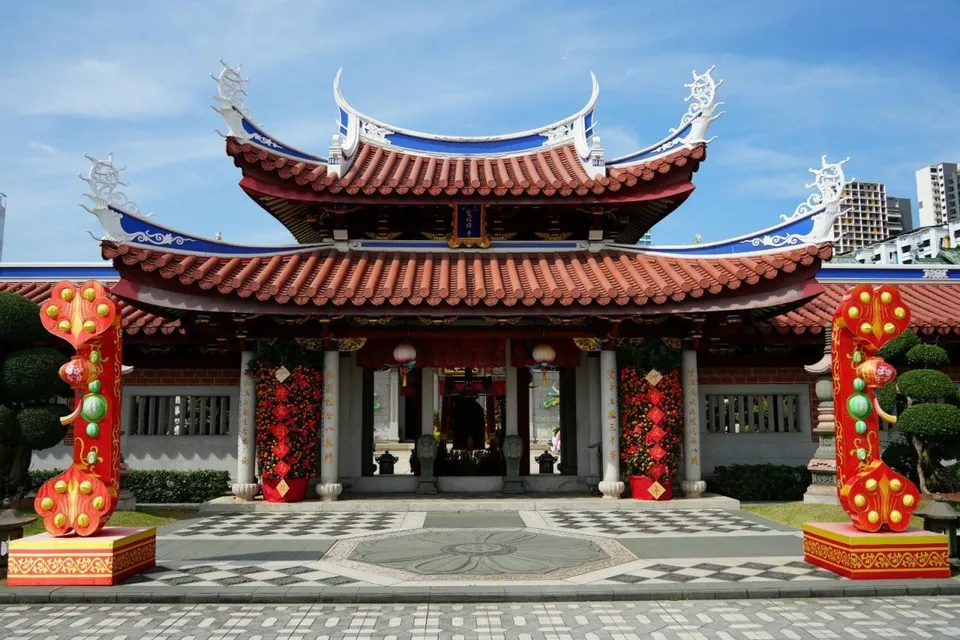
Give Lian Shan Shuang Lin an unhurried hour and it will give you the finest temple architecture in Toa Payoh, and a strong case for the finest in Singapore: swallow-tail roofs, cut-ceramic mosaics and two halls gazetted together as a National Monument, against a backdrop of HDB blocks. It is a working monastery where monks still live, so the compromise is behaviour, not tickets: dress modestly, keep voices down and give worshippers room. Aim for a weekday morning.
It looks like a scene from another century because it is. In 1898 Fujian merchant Low Kim Pong and his son had the same dream, and soon after a group of twelve monks and nuns returning from a six-year pilgrimage arrived on the shore. Low took it as a sign, and in 1900 transferred 12 acres of Toa Payoh land to one of the monks, Venerable Xian Hui, and invited him to be abbot. Construction followed in stages, funded largely by Low and public donations: the Dharma Hall in 1903, the Mahavira Hall in 1904, the Hall of Heavenly Kings in 1905 and the Drum and Bell Towers in 1907. Materials and craftsmen came from China, and the complex was modelled on Xi Chan Monastery in Fuzhou.
The architecture rewards a slow walk. It follows a rare cong lin monastery layout that blends three Hokkien regional styles, Fuzhou, Quanzhou and Zhangzhou, each visible in the shape and pitch of the roofs. Look up for the swallow-tail ridges and the jian nian mosaics made from cut ceramics; that is where the craftsmen left their mark.
Walk it in order. Enter through the 9m Shan Men, or Mountain Gate, with its calligraphy-carved stone pillars, then pass the four Heavenly Kings flanking a smiling Maitreya before reaching the Mahavira Hall, whose double-tier roof shelters images of Shakyamuni, Bhaisajyaguru and Amitabha. Beyond the main halls are a seven-storey pagoda, a rock garden, a bonsai collection, a wishing well and a large statue of the Goddess of Mercy.
Its standing goes beyond looks. It is a record of how Mahayana Buddhism spread through the region, and you may also hear it called Siong Lim Temple. Not everything is original: the Dharma Hall had to be rebuilt in the 1970s after its timber rotted, and a major restoration that began in 1991 ran for 11 years to return the complex to its original condition.
Children will find plenty to look at, from the Heavenly Kings to the bonsai, as long as they can manage the quiet. Entry is free. Come in the morning before the heat settles on the courtyards, and leave time to stand back at the end and look at the 1900s roofline against the flats; there aren't many places in Singapore where the two sit this close.
Good to know 184 Jalan Toa Payoh. Open daily and free to enter; dress modestly and keep voices low around worshippers.
Lian Shan Shuang Lin Monastery | 184 Jalan Toa Payoh, Singapore
Plan your visit
- Where
- 184 Jalan Toa Payoh, Singapore
- Opening hours
- Daily 8am–5pm
- Cost
- Free to enter, open daily 8am–5pm (Wonderwall.sg)
- Good for
- A friend, A group, Myself
Details checked 11 October 2026.
- Hidden gems in the neighbourhood of Toa Payoh · SilverKris (Singapore Airlines)
- The ultimate guide to Toa Payoh · Time Out Singapore
- Former Siong Lim Temple (now Lian Shan Shuang Lin Monastery) · Roots.gov.sg (National Heritage Board)
- Best temples in Singapore to visit with kids · HoneyKids Asia
- 8 Heritage Temples in Singapore to visit · Home & Decor Singapore
- Price source
- Opening hours
- Opening hours (official)
Researched from the sources listed, not a first-hand review. Prices, hours and access can change — check the official site before you go.